Kenya’s Circular Economy Ecosystem in 2025: Lessons from the Circular Economy Innovation Cluster
As momentum grows globally for regenerative and circular approaches, Kenya is emerging as one of Africa’s most compelling examples of a country embedding circularity into its industrial, urban, and entrepreneurial systems. Rapid urbanisation, rising consumer demand, and mounting waste challenges have created both the urgency and opportunity to reimagine linear production. But Kenya’s progress isn’t just reactive. It reflects a proactive national agenda to align climate action, industrialisation, and sustainable livelihoods.
Kenya is increasingly positioning itself as a regional hub for circular innovation: a place where entrepreneurs, investors, and public institutions can co-create scalable, inclusive models for reuse, resource recovery, and waste prevention. This journey is rooted in enabling policy and driven by an ecosystem of innovators.
A Policy Landscape that Enables Circularity
Over the past decade, Kenya has made important strides in building a regulatory and fiscal environment that supports circular economy models:
- Plastic Bag Bans (2017, 2024): Kenya led globally in banning single-use plastic bags in 2017. In 2024, it further restricted their use in organic waste management, pushing demand for compostables and reusable systems.
- Extended Producer Responsibility (EPR): First introduced in 2021 and significantly expanded in 2024, Kenya’s EPR regulations require producers to take full lifecycle responsibility for their products. This has helped formalise waste management ecosystems and created new demand for reverse logistics services.
- Green Fiscal Reforms: The 2024 draft Green Fiscal Incentives Policy outlines tax incentives for sustainable enterprises and the creation of green bonds, concessional loans, and potentially a green investment bank to mobilise capital into low-carbon, circular business models.
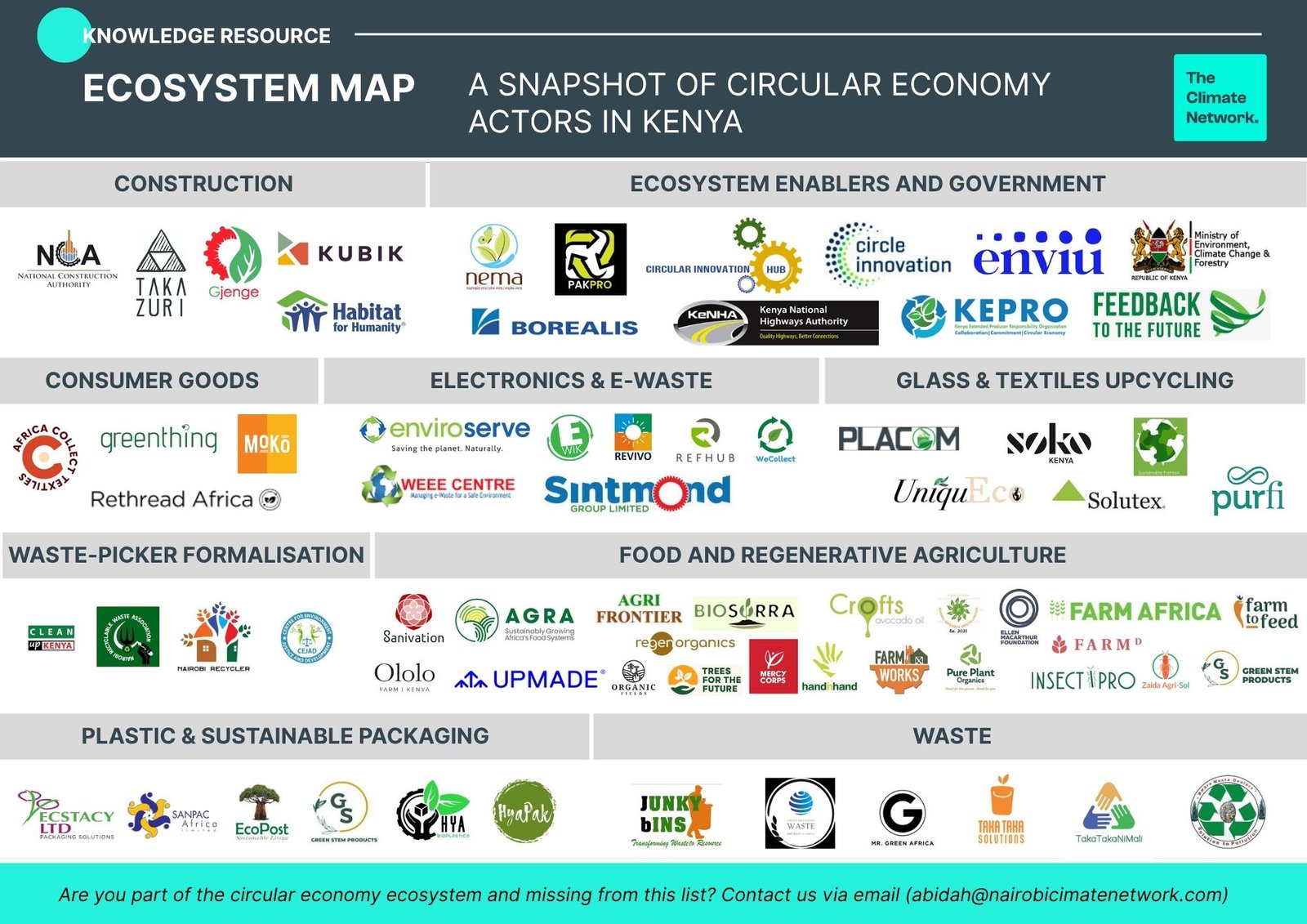
Compared to peers in the region, Kenya’s circular policies are among the most ambitious. Yet implementation varies across counties, and enforcement capacity remains uneven. This points to the continued need for coordinated governance. These policies have catalysed growth in circular enterprises across sectors. Many of these businesses are active members of the Nairobi Climate Network. Kenya’s entrepreneurs are not just reacting to waste. They are redesigning systems upstream.
- Regenerative Agriculture: Startups like Regen Organics are introducing organic inputs, compost systems, and circular distribution models that reduce both emissions and soil degradation.
- Glass and Textile Recycling: Enterprises like Green Thing are recovering materials, creating local manufacturing inputs, and generating youth employment in waste-sorting and remanufacturing.
- E-waste Solutions: Social enterprises are refurbishing devices, recovering metals, and diverting electronics from landfills while training digital repair technicians.
- Plastic Alternatives: Local innovators are producing cassava- and sugarcane-based biodegradable packaging and running refill models for household products.
- Waste Picker Integration: Organisations are formalising informal collectors through cooperatives, digital platforms, and traceable supply chains. This enhances income security and social protections.
However, persistent challenges remain. These include limited infrastructure for sorting and recycling, fragmented regulations across counties, and financing gaps for scale. Despite national policy momentum, circular entrepreneurs still contend with a market and investor landscape that defaults to linear models.
Innovation Clusters as Enablers of Circular Change
To address these systemic challenges, the Circular Economy Innovation Cluster Nairobi was launched as a partnership between Climate KIC, GrowthAfrica, and funded by the IKEA Foundation. Its mission is to reimagine waste systems in Nairobi by supporting circular business models that uplift vulnerable communities and integrate informal workers, while aligning entrepreneurship, policy, and public-private collaboration.
As part of Climate KIC’s wider innovation cluster strategy, the Nairobi Circular Economy Innovation Cluster strengthens local climate innovation ecosystems by connecting actors who often operate in silos. Through collaboration, shared learning, and inclusive engagement, the cluster helps to create conditions where diverse circular solutions can thrive and scale.
One of the Cluster’s key aims is to unlock impact-driven innovation by creating the right enabling conditions for portfolios of solutions to meet local needs and scale.
In 2024, the Cluster began creating enabling conditions for impact-driven circular innovation by convening diverse actors, aligning local needs with technical and business support, and launching the Circular ClimAccelerator. The programme combined:
- Tailored business coaching and technical advisory
- Systems-thinking and circularity training
- And a core emphasis on inclusive innovation
The programme supported 10 startups working in glass, textile, agricultural, and plastic waste recovery. With a 100 percent survival rate post-acceleration, the results reflect not only the quality of support, but also the commercial viability of circular models when integrated into well-supported ecosystems.
This year, the programme kicked off with 11 local founders who are tackling circular economy challenges across sectors like e‑waste, regenerative agriculture, packaging, and waste‑picker integration. Selected startups were all post‑revenue, Nairobi‑based businesses working for at least three years, with demonstrated social and environmental impact, and a current turnover above USD 50,000. The cohort structure mirrors the 2024 format, combining intensive audit and growth-sprint phases, workshops, one-on-one advisory sessions, and access to local and international mentorship. Importantly, up to USD 80,000 in funding will be awarded to the five most promising businesses, reinforcing the Cluster’s commitment to both scaling impact and embedding circular solutions in Nairobi’s ecosystem.
Pursuing Systems Change Through Convening
The Cluster’s influence extended beyond individual enterprises, with a parallel priority being to address the significant knowledge and skills gaps within the ecosystem – especially among youth, government agencies, and early-stage entrepreneurs seeking to apply circular principles. In partnership with the Nairobi Climate Network, it convened several multi-stakeholder forums bringing together national and county governments, industry players, informal sector leaders, investors, and youth. These forums produced a range of actionable insights, including:
- Calls to harmonise licensing and taxation for circular enterprises across counties;
- Proposals for national data hubs to support circular value chains;
- Recognition of the need to embed circularity in education and workforce development;
- And new matchmaking efforts between startups and capital providers.
The Cluster’s Circular Journey programme brought early-stage innovators into the fold. It fostered systems-thinking and media-based behaviour change campaigns. It also piloted a Train-the-Trainer programme with Nairobi County, helping public institutions build capacity for circular education and awareness at the grassroots level.
In 2025, the Circular Economy Innovation Cluster has:
- Expanded into new sectors and incubate and accelerate circular innovation
- Deepened investor relationships with tailored capital readiness support
- And will continue to track progress in job creation, enterprise scale, and environmental and circular impact outcomes.
The upcoming Circular Economy Forums, hosted by the Nairobi Climate Network and partners, will build on this momentum. They will focus on investment pathways, policy innovation, and supply chain collaboration. These gatherings aim to position Kenya’s circular entrepreneurs as integral to Africa’s wider green industrialisation push.
Kenya’s circular transition offers valuable lessons for Africa and beyond. It demonstrates that when climate ambition is matched by policy intent, entrepreneurial talent, and ecosystem coordination, new industrial models become possible. Kenya is not just responding to the global circular economy imperative. It is helping shape what a regenerative, inclusive, African model could look like.
“Creating a collaborative ecosystem for circular economy innovation in Nairobi requires recognising the complexity of waste management and embracing diverse solutions. One size does not fit all, innovation can come from anywhere. Our approach prioritises inclusive stakeholder engagement, continuous adaptation, and systemic learning. By involving private and public sector leaders, informal groups, investors, entrepreneurs, and passionate young changemakers, we break silos and harness Nairobi’s unique challenges and opportunities to drive impactful, scalable solutions.”
Patrica Jumi, Managing Director GrowthAfrica.
Title
Kenya’s Circular Economy Ecosystem in 2025: Lessons from the Circular ClimAccelerator
Author(s)
Climate KIC, GrowthAfrica and the Nairobi Climate Network
Published
2025
Download Circular Economy Ecosystem Map